
Salience in GEO & AEO: The Hidden Signal That Determines Whether AI Understands You
If you are investing in Generative Engine Optimisation (GEO) or Answer Engine Optimisation (AEO), you need to understand one core concept:
Salience.
Not keywords.
Not density.
Not even schema alone.
Salience is the signal that tells AI systems what your content is actually about.
And if you do not control it, you do not control how platforms like Google AI Overviews, ChatGPT, or Perplexity interpret your brand.
This article breaks down:
-
What salience is (technically, not loosely)
-
How Google calculates it
-
Why it directly impacts AI visibility
-
How SemanticOS helps you measure and engineer it
What Is Salience?
In Natural Language Processing (NLP), salience measures how central an entity is within a piece of content.
An entity is a defined concept such as:
-
A person
-
A company
-
A product
-
A location
-
A topic with a Knowledge Graph identity
Google’s NLP systems assign each detected entity a salience score between 0 and 1.
-
1.0= Core topic of the content -
0.1= Mentioned, but not central
This means two pages can mention the same entity — but only one will be understood as being about it.
That distinction is the difference between AI citation and invisibility.
How Google Uses Salience
Google exposes salience through the Google Cloud Natural Language API.
When you run content through it, you receive:
-
Detected entities
-
Knowledge Graph matches
-
Entity types (Person, Organisation, Location, Event, etc.)
-
Salience scores
This system underpins how Google:
-
Determines topical focus
-
Associates content with Knowledge Graph nodes
-
Powers AI Overviews
-
Evaluates entity relevance in search
Salience is not a vanity metric.
It is structural.
Why Salience Matters for GEO & AEO
Traditional SEO asked:
“Does this page rank for the keyword?”
GEO asks:
“Does the AI understand this page as authoritative for this entity?”
AEO asks:
“Will this page be selected as a source when a user asks a question about this topic?”
Salience directly affects both.
If your brand, product, or service entities are low-salience relative to surrounding generic entities, AI systems may:
-
Misclassify your topic
-
Associate your page with adjacent concepts
-
Prefer competitor content with clearer entity hierarchy
This is where most websites fail.
They mention their core offering — but they do not structurally reinforce it.
The Salience Problem Most Businesses Have
Here is what typically happens:
-
A page targets “Roof Repair in Hampshire.”
-
It mentions:
-
Weather damage
-
Insurance claims
-
General construction
-
Roofing materials
-
-
The core service entity appears only a few times.
-
Google assigns higher salience to generic construction or weather entities.
Result:
AI does not see you as the authority on your intended subject.
You rank inconsistently.
You are not cited in AI responses.
Your entity graph is diluted.
Enter SemanticOS
SemanticOS was built specifically to solve this structural problem.
Not traditional SEO, not keyword stuffing, but AI-native optimisation.
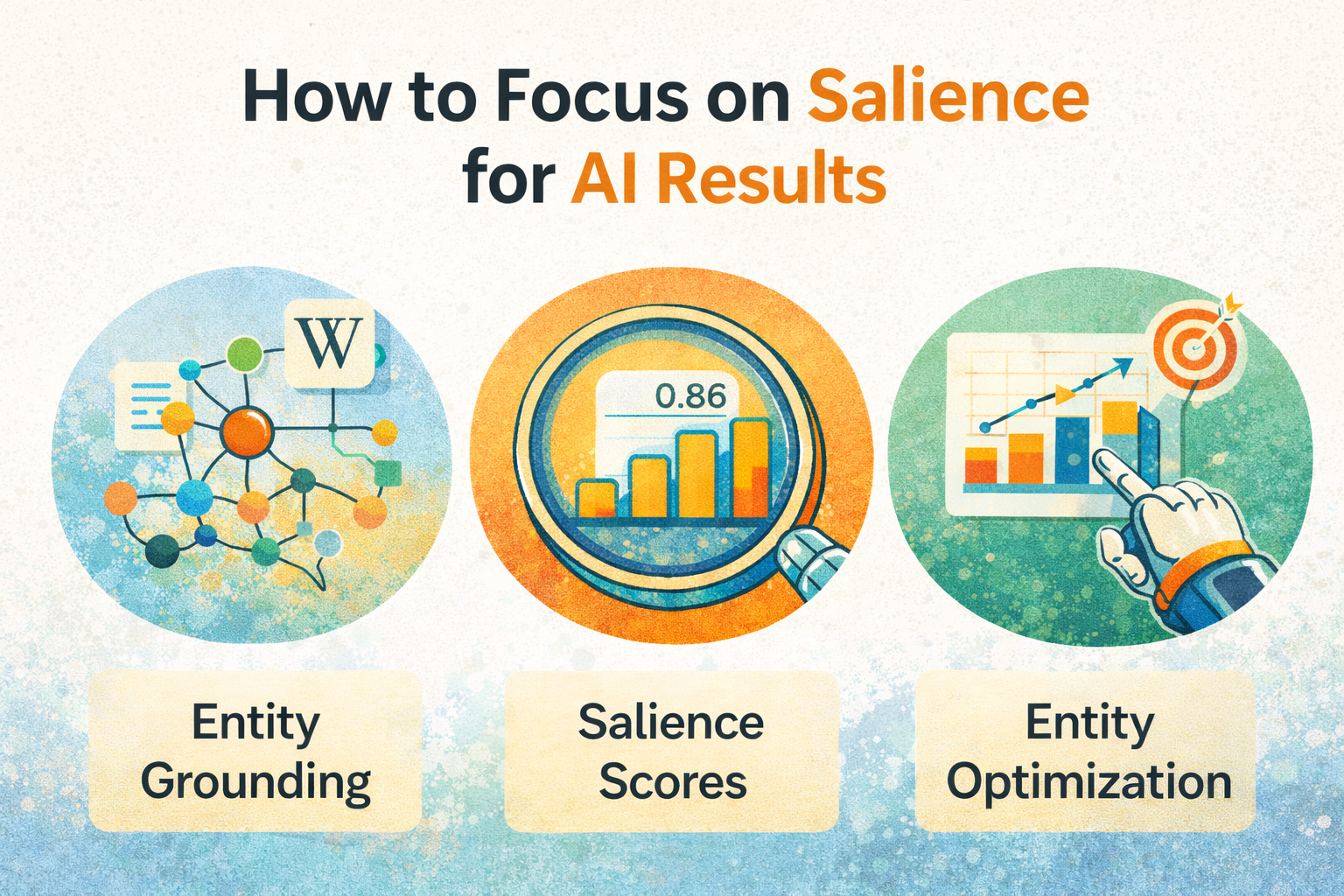
1. Wikipedia Entity Grounding
One of the biggest challenges in salience optimisation is ambiguity.
Is “Apple” a fruit or a company?
Is “Surrey” the UK county or somewhere else?
SemanticOS performs Wikipedia and Wikidata grounding, aligning your entities with:
-
Verified Knowledge Graph IDs
-
Canonical references
-
Disambiguated entities
This mirrors how Google resolves entities internally through systems like the Google Knowledge Graph.
The benefit:
AI systems no longer guess what you mean.
They see structured, grounded, canonical entities.
2. Entity-Level Salience Scoring
SemanticOS does not just extract entities.
It calculates relative salience within your content.
You can see:
-
Which entities dominate your page
-
Which core commercial entities are under-weighted
-
Where contextual dilution is occurring
-
How internal linking affects entity reinforcement
This gives you something most SEO tools do not:
A measurable signal of topical authority before publishing.
You are not hoping Google understands your page.
You are engineering that understanding.
3. Alignment With Google NLP for Developers
Google’s developer-facing NLP tools expose salience.
SemanticOS mirrors that logic so you can:
-
Preview how content may be interpreted
-
Adjust entity prominence
-
Reinforce target nodes
-
Structure entity relationships
Instead of reverse-engineering rankings, you are aligning with the underlying interpretation layer.
That is the difference between SEO and AI optimisation.
4. Entity Graph Reinforcement Across Your Site
Salience is not just per page.
It compounds across your domain.
SemanticOS builds:
-
Entity registries
-
Site-wide relationship graphs
-
Internal link intelligence
-
Structured AI endpoints (LLMs.txt, JSON entity outputs)
This means your site develops:
-
A coherent entity hierarchy
-
Reinforced commercial focus
-
Clear topical clustering
AI models favour structured, consistent entity ecosystems.
Most sites are fragmented.
Why This Is Commercially Critical
If AI platforms are increasingly answering queries directly, the game changes.
You need to be:
-
Referenced
-
Cited
-
Extracted
-
Trusted
High salience = higher probability of AI selection.
Low salience = background noise.
This is not theory. It is already visible in how:
-
AI Overviews summarise pages
-
Chat-based engines cite sources
-
Retrieval-augmented systems choose context
When your commercial entities consistently appear as high-salience nodes across your site, your visibility profile changes.
What This Means for Agencies
If you are an agency:
Salience gives you:
-
A measurable AI optimisation metric
-
A structured reporting layer
-
A differentiated service beyond technical SEO
-
A way to justify GEO retainers
Instead of promising “AI readiness,” you can demonstrate:
-
Entity grounding
-
Salience improvement
-
Knowledge Graph alignment
-
Structured AI endpoints
That is defensible positioning.
What This Means for Businesses
If you are a business owner:
Ask yourself:
-
Does AI clearly understand what we do?
-
Are our service entities structurally dominant?
-
Are we grounded to canonical Knowledge Graph nodes?
-
Is our site building entity authority — or just publishing blog posts?
If you do not know the answer, you are operating blind in an AI search era.
The Strategic Shift
Search is no longer just about matching queries.
-
It is about entity interpretation.
-
It is about salience weighting.
-
It is about Knowledge Graph alignment.
That is why SemanticOS exists.
Not as another SEO plugin.
But as an AI Data Layer for the generative web.